Skip to Content

Medicina

Medicina is an international, peer-reviewed, open access journal covering all problems related to medicine, published monthly online. 
It is the official journal of the Lithuanian University of Health Sciences (LUHS). The Lithuanian Medical Association (LMA)Vilnius UniversityRīga Stradiņš UniversityUniversity of Latvia, and University of Tartu are affiliated with Medicina, serving as their official journal. Members of these organizations receive discounts on the article processing charges.
Indexed in PubMed | Quartile Ranking JCR - Q1 (Medicine, General and Internal)

All Articles (12,910)

Background and Objectives: Pulmonary embolism (PE), the third most prevalent cause of cardiovascular death, is often regarded as a potentially fatal condition. Renal function has been shown to affect the short- and long-term prognosis of acute PE in several large registries. Therefore, the purpose of this study is to investigate the relationship between acute kidney injury (AKI) and the lactate-to-albumin ratio (LAR) in patients hospitalized for PE. Materials and Methods: 264 PE patients were included in this retrospective analysis. Based on the presence or absence of AKI, the study population was split into two groups. Results: Of the 264 patients included in our study, 161 (61%) were female. The median age was 67 ± 16 years. The sample was divided into two groups based on whether AKI developed (No AKI group, n = 176; AKI group, n = 88). A multivariate logistic regression analysis revealed that sPESI score, receiving fibrinolytic therapy (tPA), and LAR (OR: 6.334, 95% CI: 3.070–13.069; p < 0.001) were independently associated with AKI in patients with PE. In particular, an LAR > 0.55 predicted AKI in patients with PE, with a sensitivity of 75% and a specificity of 67% (AUC = 0.749, 95% CI = 0.692–0.800, p < 0.001). Conclusions: Our study demonstrates that the LAR independently predicts AKI in patients with PE. This is the first study that precisely examines this association in PE patients, as far as we are aware.

2 March 2026

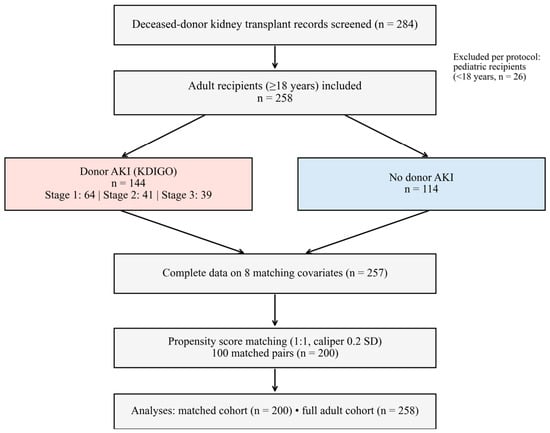
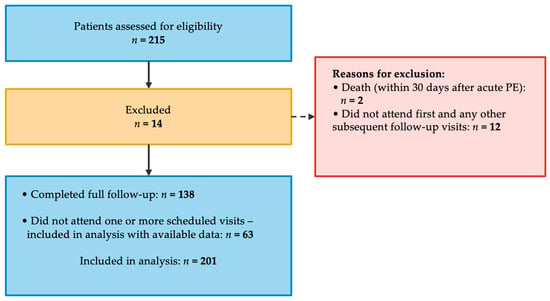
Flow chart of the study sample selection.

Introduction: Multiple sclerosis (MS) is a chronic, inflammatory, demyelinating disease of the central nervous system with a highly heterogeneous clinical course. Early identification of patients at risk of aggressive disease progression is crucial for optimizing therapeutic strategies, including eligibility for highly effective treatments. Objective: The aim of this review was to synthesize current data on prognostic factors in multiple sclerosis, with particular emphasis on their significance in the early stages of the disease and potential clinical implications. Methods: A narrative systematic review of the literature was conducted, including observational studies, cohort studies, meta-analyses, and systematic reviews on the natural course of MS, prognostic factors, and clinical, neuroimaging, and laboratory biomarkers. We comprehensively reviewed PubMed and Scopus databases, focusing on English-language publications. Study selection prioritized longitudinal studies and meta-analyses with clear outcome definitions and sufficient follow-up. Formal quality scoring was not applied due to the narrative design of the review. Results: Key adverse prognostic factors include older age at onset, polysymptomatic onset, high relapse activity in the first years, incomplete remission after relapses, and the primary progressive form. Magnetic resonance imaging features, including the number and location of T2 lesions, contrast activity, the presence of spinal cord lesions, PRLs and SELs, and severe brain atrophy, also have significant predictive value. Increasing importance is being attached to laboratory biomarkers, such as oligoclonal bands, light neurofilaments, free kappa light chains, and GFAP. Conclusions: An integrated assessment of clinical, neuroimaging, and laboratory factors enables more effective risk stratification in patients with newly diagnosed MS. Early identification of an unfavorable prognostic profile may provide a basis for individualizing treatment and considering the use of highly effective therapies early in the course of the disease.

2 March 2026

Background and Objectives: Post-induction hypotension (PIH) is common in emergency spine surgery and may vary by time of day. We evaluated whether a personalized hemodynamic management (PHM) bundle was associated with reduced PIH and hypotension burden. Materials and Methods: We conducted a single-center retrospective pre–post cohort study of adults undergoing emergency decompressive or stabilizing spine surgery under general anesthesia. The PHM bundle included documentation of an individualized pre-induction MAP target (default 65 mmHg; higher for selected high-risk phenotypes), dynamic assessment of fluid responsiveness, and proactive vasopressor use (norepinephrine initiated at induction in prespecified high-risk patients), with continuous BP trajectory monitoring. PIH was defined as mean arterial pressure (MAP) < 65 mmHg or a ≥30% decrease from pre-induction MAP within 20 min. We used 1:1 propensity score matching (caliper 0.2) and provider-clustered logistic regression in the matched cohort. Results: Among 312 eligible patients (usual care n = 200; PHM n = 112), PIH varied by time of day, with the highest incidence in morning cases (46.2%; p = 0.041). After matching, 224 patients (112 per group) were analyzed. PHM was associated with lower PIH (43.8% vs. 33.0%; adjusted odds ratio 0.62; 95% CI: 0.41–0.94; p = 0.024). PHM reduced time-weighted average (TWA) MAP below target (5.7 ± 4.2 vs. 3.2 ± 3.6 mmHg; mean difference (MD) −2.3 mmHg; 95% CI −3.3 to −1.3; p = 0.001) and area under MAP < 65 mmHg (ratio 0.62; 95% CI 0.50–0.78; p < 0.001). Norepinephrine-equivalent dose was higher (Δ + 20 μg; p = 0.005) while rescue phenylephrine boluses were fewer (Δ − 1; p < 0.001); crystalloid volume was similar (p = 0.151). Conclusions: In emergency spine surgery, PIH showed time-of-day variation, and PHM implementation was associated with reduced PIH and hypotension burden.

2 March 2026

  • Correction
  • Open Access

Error in Table [...]

2 March 2026

News & Conferences

Issues

Open for Submission

Editor's Choice

Get Alerted

Add your email address to receive forthcoming issues of this journal.

XFacebookLinkedIn
Medicina - ISSN 1648-9144